Bachelor's Thesis Research

Technische Universität Wien (TU Wien)

Investigating Sputtering on Lunar Surface Analogues

I gained my first real research experience during my Bachelor's thesis at TU Wien, where I simulated the surface sputtering of lunar analogue materials under solar wind ion bombardment. As part of this project, I co-developed a custom graphical user interface (GUI) in Python to better evaluate frequency curves measured using a quartz crystal microbalance (QCM) to resolve mass removal and deposition at an atomic scale. I also implemented a filtering algorithm to suppress the associated noise and remove spurious frequency spikes in the data, resulting in improved frequency resolution.

Apart from these technical achievement, I learned one thing: Patience. I believe I speak for everyone who is working in a laboratory when I say that experiments will rarely work out the way you planned them on the first try. Instead, components will break, you may forget to set an important parameter or your data may be affected by some systematic you did not even think about. During the course of this work, I had to overcome many such obstacles and, despite feeling somewhat discouraged at the time, I can now appreciate the value in these experiences.

This project led to four co-authored publications, one of which appeared in The Planetary Science Journal. Since TU Wien does not publish Bachelor's theses online, you can download my thesis directly from this website by clicking the button below.
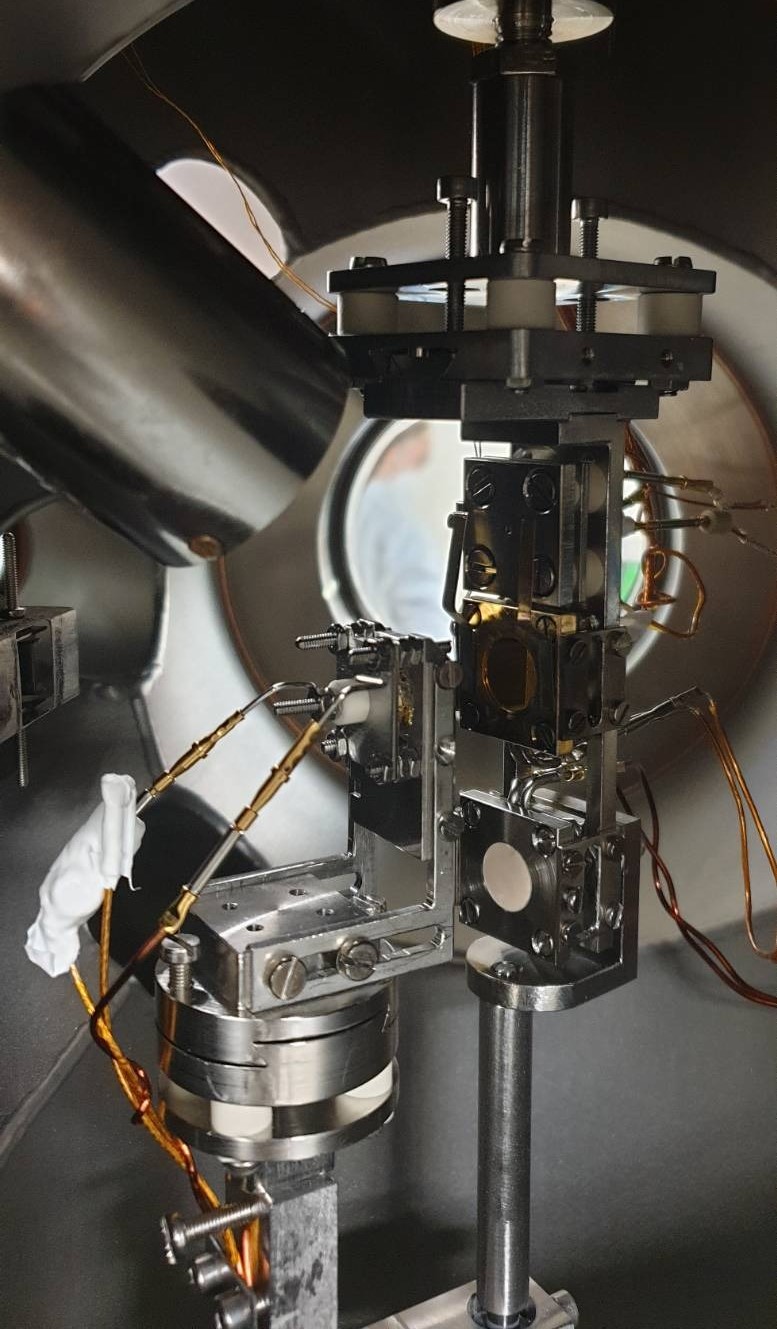
QCM catcher and target holder at TU Wien

Multiwavelength Experience

During my Master's degree in Bologna, I gained hands-on experience with several high-impact telescopes and their associated data products. In particular, I worked on three separate research projects in the X-ray, optical, and radio regime.

📡

Radio

We calibrated and processed ALMA observations of the CO(2-1) molecular gas emission in the lenticular galaxy NGC 612 using CASA, producing continuum and line images. The data were used to estimate the molecular gas mass in the spiral arms and compared to the literature.

🔭

Optical

We analysed high-resolution stellar spectra from the UVES and UVES-FLAMES spectrographs at VLT to estimate the Li-abundance in turn-off stars of the globular cluster NGC 6752. Additionally, we created and presented a mock telescope proposal using the ESO Exposure Time Calculator for VLT and La Silla facilities.

🛰️

X-Rays

We downloaded and processed observations of NGC 5135 by the Chandra and NuSTAR X-ray observatories. We used DS9 to define source and background regions to extract spectra between 0.2 and 79keV and constrain its variability. Furthermore, we fit physical models to our data using Xspec to uncover the nature of the two central bright X-ray sources.

Master's Thesis Research

Alma Mater Studiorum - Universitá di Bologna

Using JWST to Investigate Dust Energy Balance in Galaxies at Cosmic Noon

The launch of the James Webb Space Telescope (JWST) has opened a new window onto the high-redshift Universe, enabling detailed studies of ionised gas and dust emission in distant galaxies. During my Master's degree in Bologna, I was fortunate enough to be able to work within the Red Cardinal research team, which is financed by an ERC Starting Grant. Under the supervision of Dr. Sirio Belli, I developed a custom photometric pipeline to obtain photometric measurements from archival data of the James Webb's Mid-infrared Instrument (MIRI) and measure the dust emission in high-redshift galaxies.

During this project, I learned how to handle and manipulate large mosaic FITS files, produce galaxy cutouts, model background emission and noise gradients in the mid-infrared, and perform precise aperture photometry. In order to keep my code clean and organised I created a GitHub project, which later became its own stand-alone Python library called miriutils and is made publcily available together with the Blue Jay MIRI Photometric Catalogue.

I measured the dust emission for 111 of 153 cosmic noon galaxies covered by the Blue Jay Survey and compared it to the mid-infrared fluxes predicted by Prospector. We find several biases within our sample towards overestimated dust emission when direct IR-observations are not available, as well as trends with dust attenuation and star-formation rate. We present our findings in an upcoming publication (Collins et. al 2026, in prep) in Astrophysics & Astronomy.

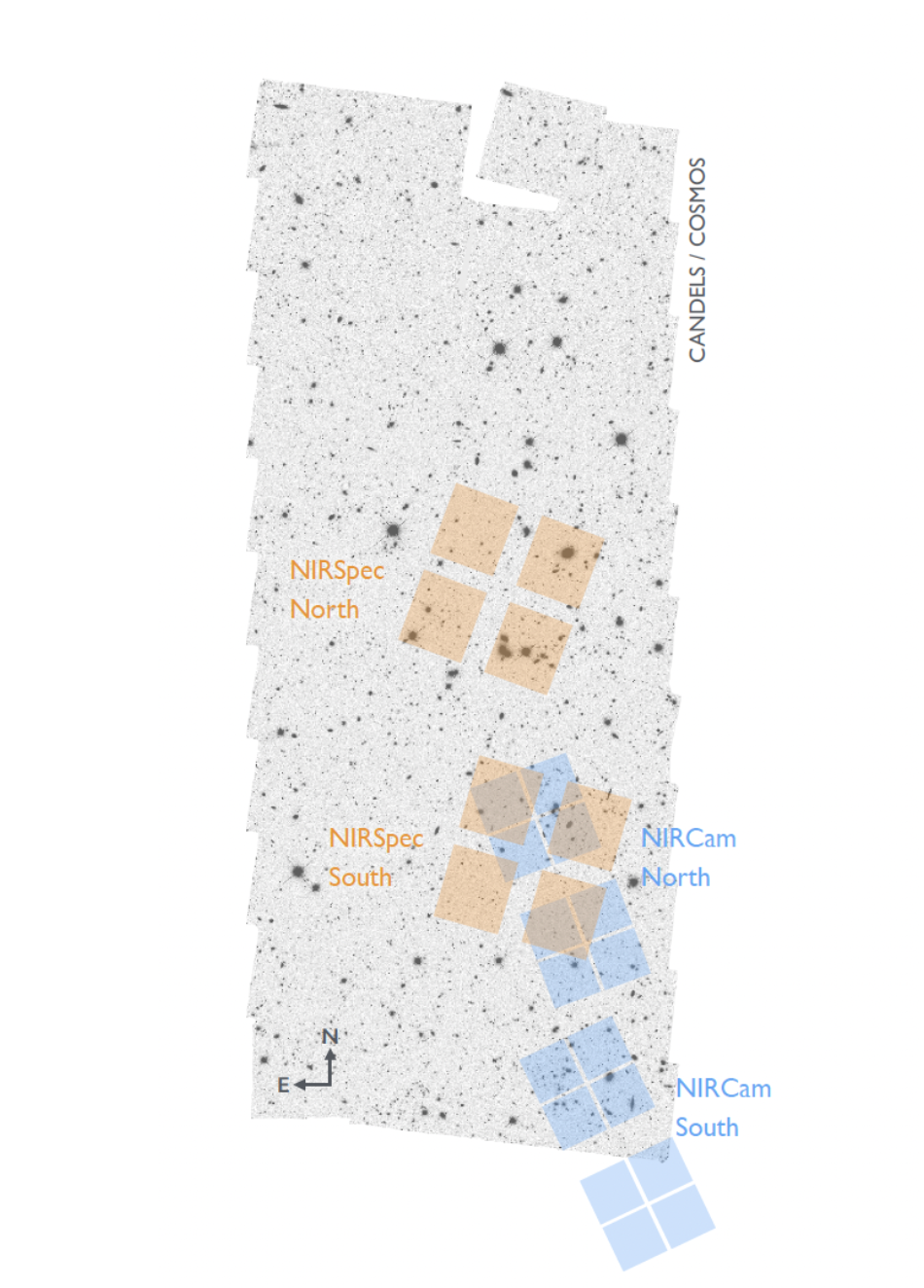
COSMOS Footprint of the Blue Jay Survey

Current Research

Universidad de Chile

Combining JWST and ALMA to Investigate Dust Emission in Galaxies at z ~ 2

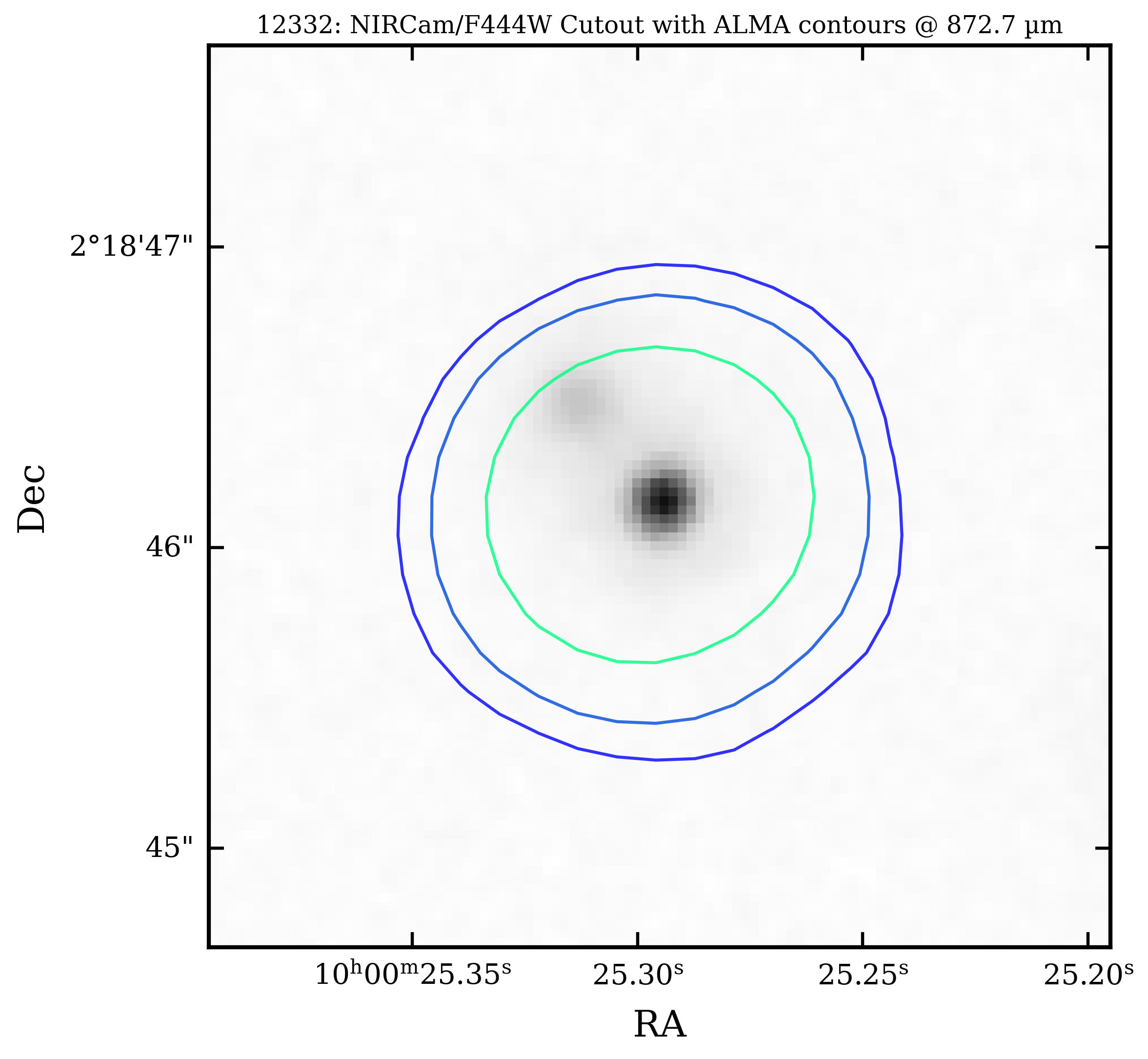
Currently I am investigating how previous data from HST and JWST can be complemented by radio observations in the (sub-)mm regime using ALMA. I make use of the publicly available A3COSMOS data products, which contain all archival ALMA observations in the COSMOS field. After cross-referencing galaxies from the Blue Jay sample with their catalogues, I obtained continuum images in ALMA bands 6 & 7 for four galaxies, opening a window onto the emission from cold dust within the ISM of these systems.

JWST image with ALMA contours